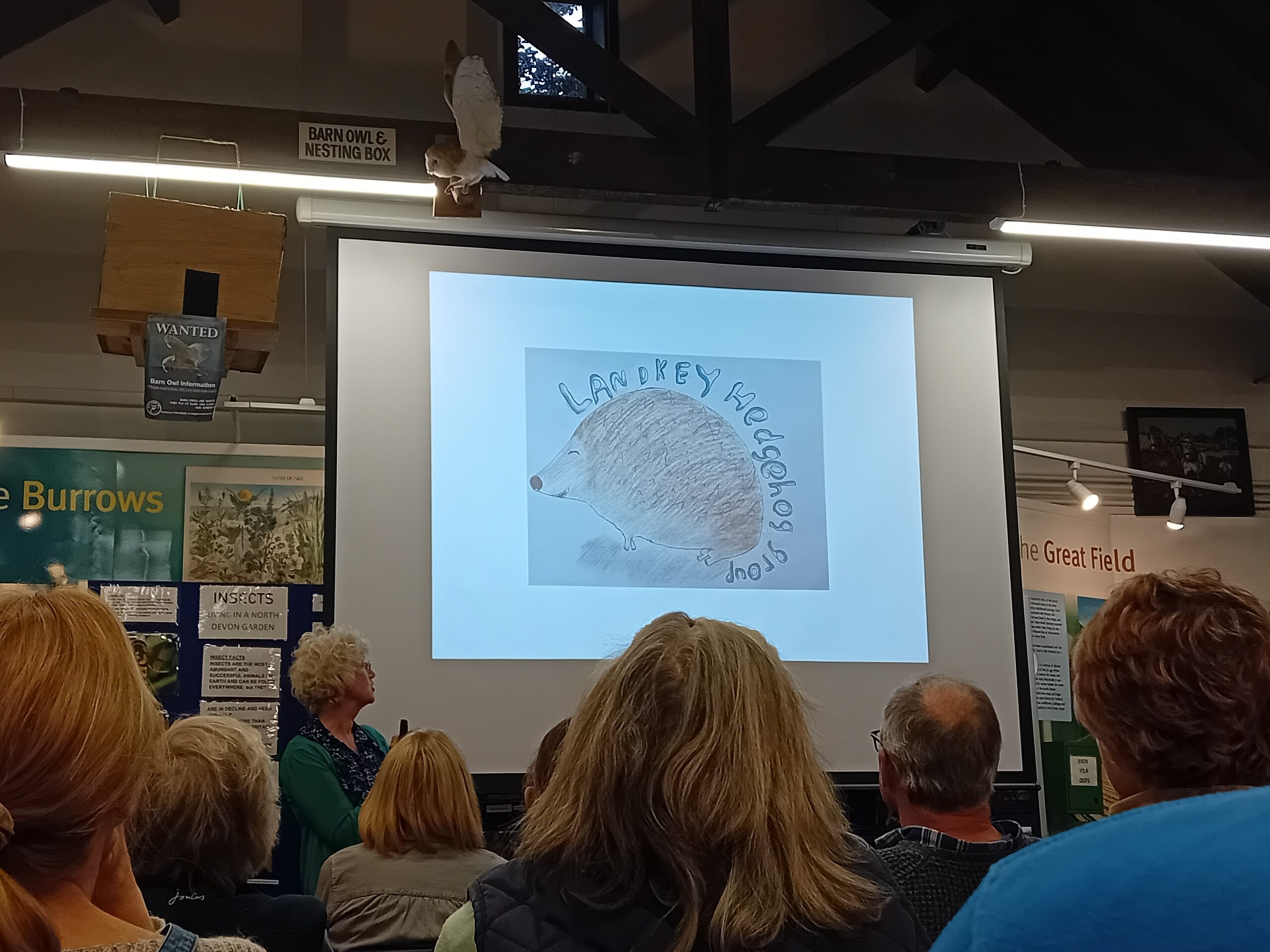
Community organisations like Landkey Hedgehog Group are vital to protect local wildlife. On the 12th of September, we welcomed hedgehog champions Karen and Mark for an evening talk to learn how to support these marvellous creatures.
Fun facts about hedgehogs
 To kick off the talk, Karen and Mark hosted a quiz to test our hedgehog knowledge and it’s safe to say we all learned something new! Did you know…
- Hedgehogs have 44 teeth!
- A group of hedgehogs is called an ‘array’
- Hedgehogs live for 2-5 years
- When a hedgehog doesn’t like a certain smell, it will ‘self-anoint’ – covering itself in saliva
- 600-800g is the optimal weight for a hedgehog before hibernation
Landkey Hedgehog Group’s mission

Founded in September 2022, the Landkey Hedgehog Group raises awareness of hedgehogs in the community through talks and events and by collaborating with local organisations. The group has worked with the North Devon Biosphere and the South Molton Men’s Shed and was even recognised by the national Hedgehog Street initiative. Although it isn’t a hedgehog rescue, the group supports two fantastic local wildlife rescues – The Littlest Wildlife Hotel and Barny Hogs.
Landkey Hedgehog Group even has an adorable mascot (a cuddly hedgehog plush), which was named ‘Herbert’ by a pupil at Landkey Primary School as part of a competition.
Why are hedgehogs in decline?
After an introduction to the group, Karen delved into the statistics. In the 1950s, there were approximately 36 million hedgehogs in Britain. Sadly, today, this figure is estimated to be around 800,000.
Some of the biggest threats to hedgehogs are habitat loss (especially in rural areas); tidy gardens (no leaf litter or log piles for nesting/food); pesticides; strimmers; increased road traffic; bonfires; getting trapped in plastic litter thrown from cars; drowning in ponds without access ramps; badgers and flystrike, roundworm, and ticks.
Making hedgehog highways
When hedgehogs can travel freely between gardens, they can safely forage for food and find suitable nesting sites without having to risk crossing the road. Making a hedgehog highway is as simple as creating a hole in your fence (approximately 13 x 13 cm). Braunton Parish Council recently signed up for the Hedgehogs R Us Highway Project and is offering locals free hedgehog-shaped fence surrounds to create hedgehog highways in the community.
The Landkey Hedgehog Group has also installed hedgehog crossing signs in the village, prompting drivers to look out for hedgehogs crossing the road at night. “We take the signs down in November and put them up again in March,” said Karen, “as people often start to ignore signs if they’re in place for a long time.”
More ways to create a hedgehog-friendly garden

After the talk, we watched some beautiful (and hilarious) footage of hedgehogs roaming around Mark’s garden at night. As it turns out, hedgehogs aren’t the most social creatures, so we did see one hedgehog push the other headfirst into the water dish! Although they’re a little antisocial, hedgehogs are an absolute joy to watch via a wildlife camera if you have one. Here are some recommendations from Landkey Hedgehog Group on how to attract hedgehogs to your garden:
Create a feeding station

Providing supplementary food for hedgehogs is a great way to attract them to your garden. Karen recommended dry cat or dog biscuits, or tinned cat or dog food, along with a shallow dish of water. Hedgehogs are lactose intolerant, so they must not be fed milk or other dairy products. Hedgehogs also should not eat mealworms, as they are high in phosphorus and low in calcium, which can lead to Metabolic Bone Disease.
If you’d like to create a more sophisticated feeding station, why not take inspiration from The Men’s Shed? They built feeding stations with built-in predator protection in the form of a double entrance and tunnel (see photo above).
Keep areas of your garden wild
Hedgehogs look for untidy areas with leaves, logs and twigs to build their nests, so keep an area of your garden ‘wild’. These environments also attract a variety of invertebrates, such as beetles, worms, and woodlice, which are a food source for hedgehogs (delicious!).
Be careful when strimming
Sadly, many hedgehogs are brought to rescue centres with severe injuries from strimmers. Always check areas of your garden before strimming to make sure no hedgehogs are nestled in the long grass.
It was a pleasure to welcome Karen and Mark to the Centre and we’re very grateful for all their advice. We also loved chatting with everyone and sharing stories about our hedgehog visitors. Hedgehogs are magnificent creatures, and it is a privilege to see them wandering in our gardens. Let’s do what we can to help our prickly friends!
Keep an eye on our Events Calendar for more evening talks at Braunton Countryside Centre.
Hedgehog rescues in North Devon
Barny Hogs (Barnstaple) – 07398 495124
The Littlest Wildlife Hotel (South Molton) – 07481 801447
North Devon Animal Ambulance – 07817 995751